
Is there a free alternative to WA Sender for group messaging?

Yes — the free routes are WhatsApp's own broadcast lists (up to 256 contacts, contacts only) and Communities, plus free-tier Chrome extensions like WAMessager (50 messages a day free) and SafePace (50 messages a day free). FivePlus is not permanently free: it is free to try for 24 hours, then paid.
If you're a coach or freelancer who has just hit a wall in WA Sender and you want the same job done for free, the honest answer is that "free" has a ceiling. The ceiling is usually 256 contacts, or 50 messages a day, or your account. This guide walks through each free route, what it really costs you, and when paying is the cheaper choice.
If you already know you want a dedicated tool that goes past 5 recipients in one click, you can get FivePlus for WhatsApp Chrome extension (bulk share beyond 5 recipients) and test it inside the 24-hour trial.
What counts as a free WA Sender alternative?
A free alternative is any route that sends one message to many people at no cost — and there are only three honest kinds: WhatsApp's built-in tools, free tiers of Chrome extensions, and moving your audience to another platform.
Everything else is a trial, a freemium cap, or a paid plan wearing a free label. That distinction matters most for a free wa sender alternative, because the thing you're replacing isn't just the sending — it's the convenience of picking a list and hitting send once.
Can you message many WhatsApp groups for free without any tool?
Yes — WhatsApp's own broadcast lists and Communities cost nothing and are the only officially allowed routes, but each has a hard ceiling.
Broadcast lists: free, private, capped at 256
A broadcast list sends one message to several contacts at once, and each person receives it as an individual chat. It works like BCC: recipients don't see who else got it, and replies come back to you privately (Mailrelay, 2026).
The catch is the number. A WhatsApp Business broadcast list is limited to 256 contacts, and larger audiences need the WhatsApp Business API (Wati, 2026). Broadcast lists are free to use (Zenvia, 2025).
Here's the part most guides skip: a broadcast list reaches contacts, not groups. If your workflow is "post this announcement in my 20 client groups," broadcast lists don't do that job.
Communities: free, but only for groups you bring in
Communities let you consolidate the groups you manage so one announcement reaches everyone (9bot, 2026). It's free and it's official.
The limit is membership: a Community only reaches groups you bring into it, and WhatsApp groups are capped at 1,024 members (Automate AI, 2026). Your existing client groups don't magically join — you'd have to rebuild them inside the Community.
Do free Chrome extension senders really stay free?
Some do, within a daily cap — WAMessager advertises "50 msg/day in FREE PLAN: FREE FOREVER," and SafePace lists 50 messages a day free per number (Chrome Web Store listings, 2026).
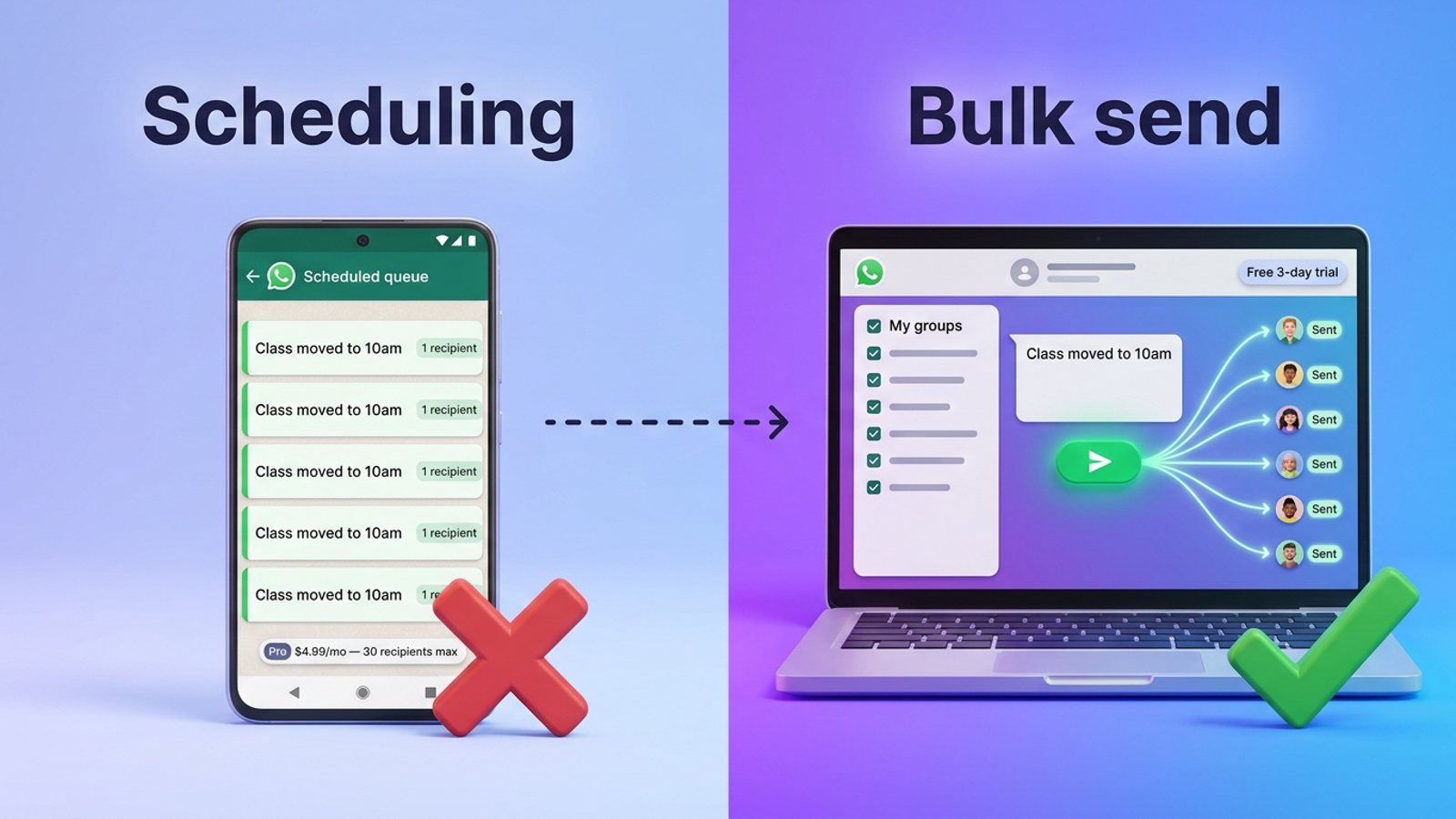
Those are vendor claims on their own store pages, not independent tests. What the listings do show is the shape of the free tier: a daily message ceiling, with paid plans above it. SafePace's own listing prices Pro at $4.99/month for one number and Pro Max at $9.99/month for five numbers (as of November 2026, prices can change).
There's also a "Free Bulk WhatsApp Sender & Contact Exporter" that advertises everything free forever, with a Pro tier at ₹499/month for attachments and spintax (Chrome Web Store, updated 18 November 2026).
So yes, free tiers exist. What they don't remove is the underlying risk.
Is a free bulk sender safe for your WhatsApp account?
No free sender is risk-free, because WhatsApp's rules apply to all of them equally — and WhatsApp says it uses on-platform signals to identify and stop abusive accounts.
Two mechanisms matter. First, WhatsApp enforces throttling: unnatural volume spikes without pacing can get an account restricted or flagged, leading to spam reports, blocked numbers, delivery problems and bans (Respond.io, 2026). Second, sending unsolicited promotional messages without opt-in is described as one of the most common and costly mistakes, driving spam reports (Respond.io, 2026).
Meta's enforcement page describes escalating penalties for repeated policy violations such as spam: warning, then blocks, then account lock, then permanent disablement (Meta for Developers, updated 21 May 2026).
And the free tools themselves are fragile. Unofficial free bulk senders are described as often getting banned after a short time or breaking after a WhatsApp update, leaving users with a compromised number (Greenbubble.io, 2026).
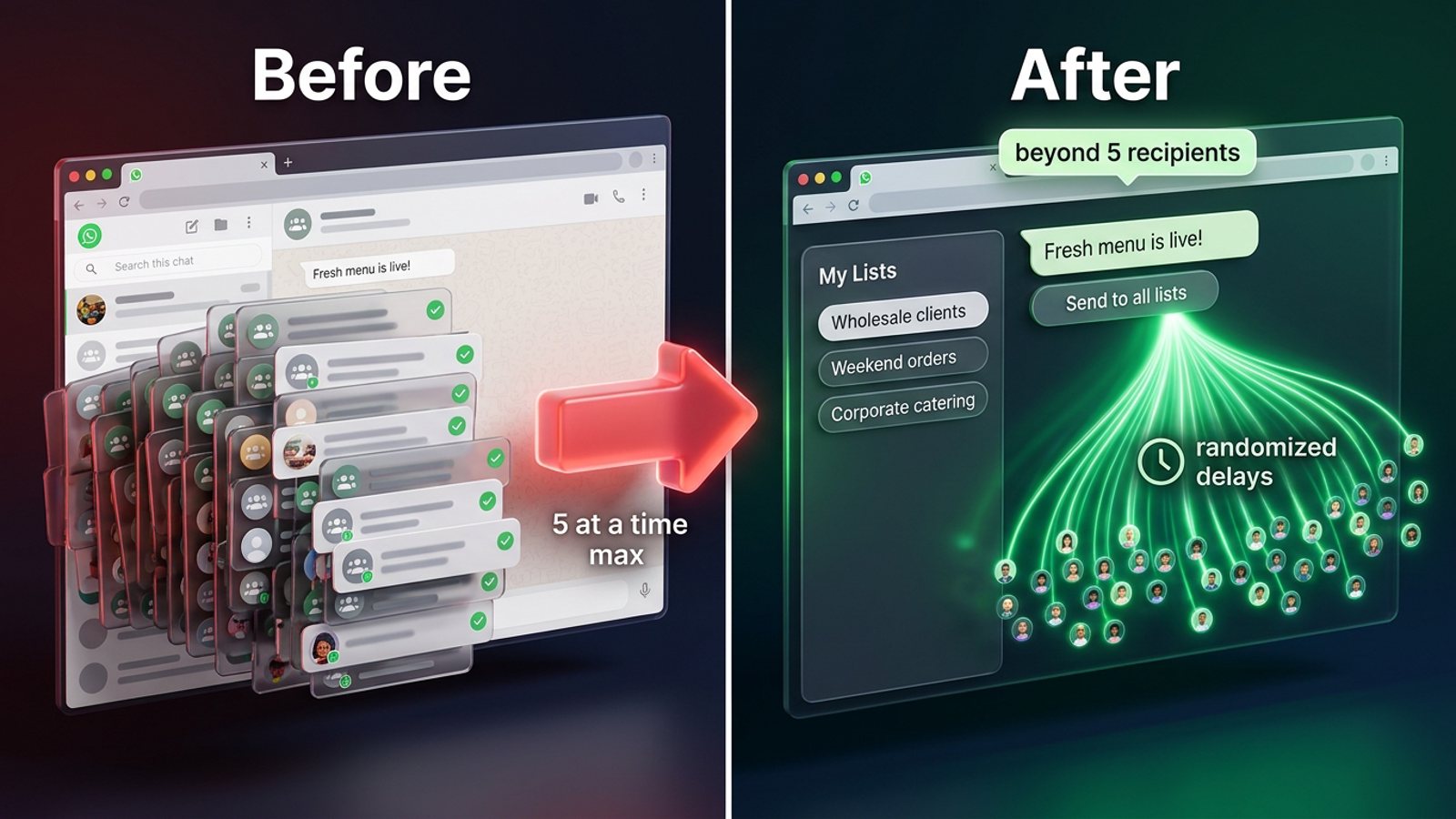
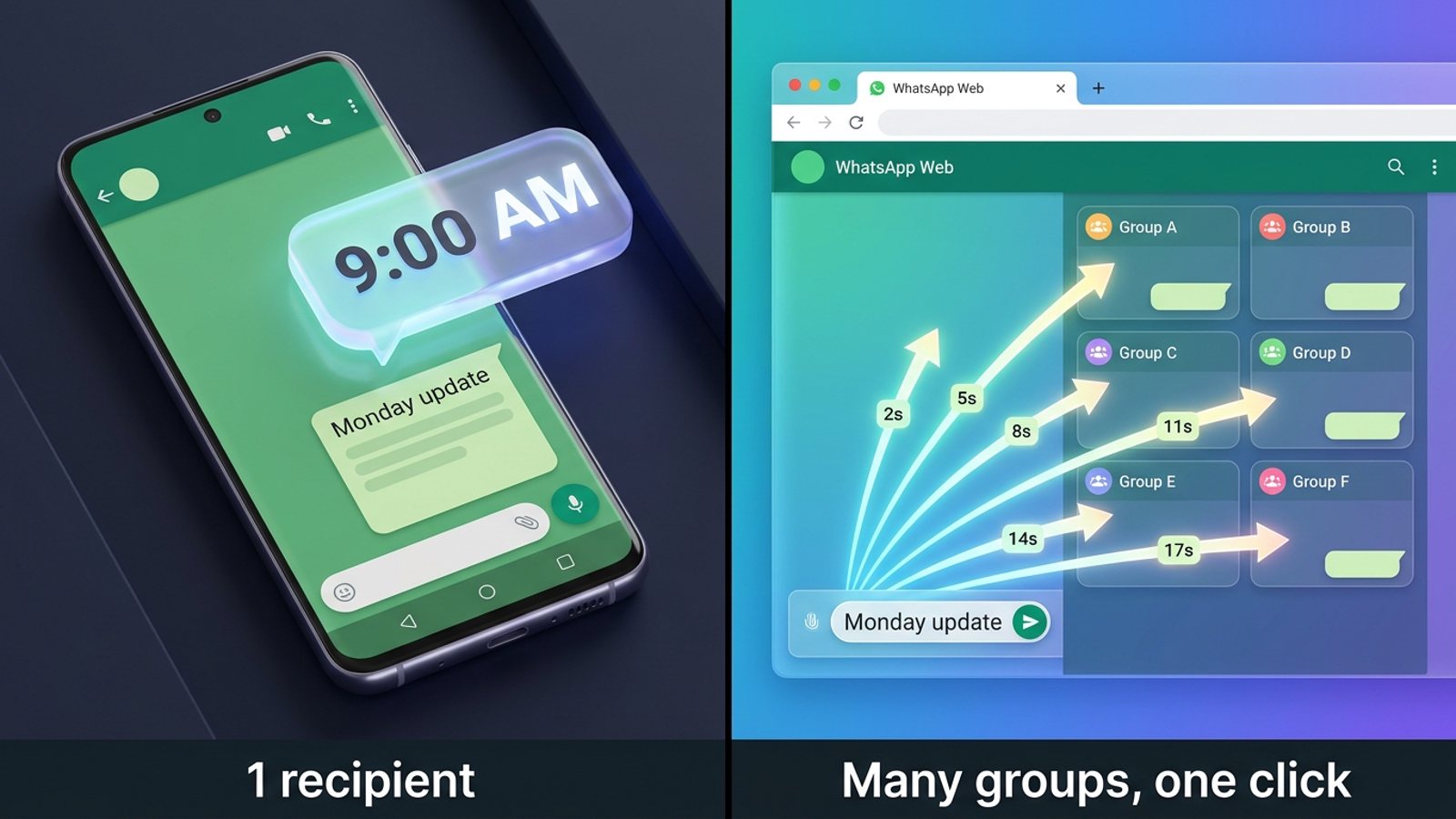
This is where a paid tool earns its place — not by making risk disappear, but by pacing messages so volume looks human. FivePlus uses anti-ban technology that mimics natural human behaviour and randomized delays to stagger message timing, and it saves your group lists as presets so you're not rebuilding them each time. Those features are the reason people stop looking for free.
How does FivePlus compare with the free options?
FivePlus is our pick of the tools we compared for one reason: it sends to more than 5 recipients in one click, with saved presets and randomized delays — but it is a 24-hour trial, then paid, so it is not the free option.
FivePlus is made by the team behind this blog.
| Option | Best for | Key features | Price/free option | Watch-outs |
|---|---|---|---|---|
| FivePlus (Our pick) | Coaches and freelancers sending to many groups at once | Saved group presets, unlimited sharing, randomized delays, mix people and groups | Free to try for 24 hours, then paid (as of Nov 2026, prices can change) | Chrome and WhatsApp Web only; not permanently free |
| WhatsApp broadcast lists | Contacts-only announcements under 256 | Private one-to-one delivery, free | Free | 256-contact cap; contacts only |
| WhatsApp Communities | Groups you already manage | One announcement to member groups | Free | Only groups you bring in; 1,024-member group cap |
| WAMessager | Trying bulk sending at zero cost | CSV/Excel import, delays, batching | 50 messages/day free (vendor claim) | Unofficial automation; ban risk |
| SafePace | Small daily volumes on a budget | Auto-paced sending, personalisation | 50/day free; Pro $4.99/mo (Nov 2026) | Vendor states no zero-risk bulk sending |
| Telegram channel | Audiences you can move platforms | No follower limit on channels | Free | Different app; audience must join |
Read the table as a map of trade-offs, not a ranking of quality. If you mainly need contacts-only messages under 256 people, WhatsApp's broadcast list is the more direct choice — and it's free forever. If your audience can move to Telegram, a channel removes the follower limit entirely (Automate AI, 2026), though you can't message WhatsApp groups from it.
If you need to send to dozens of existing WhatsApp groups in one click, that's the job FivePlus was built for — start the 24-hour trial here and see whether the saved presets save you enough time to justify the paid plan.
"Free" is a price, not a feature — the real question is what the free route costs you in reach, in daily caps, or in account risk.
What is the real free limit of WhatsApp broadcast lists?
256 contacts per list — that's the number to plan around. The same cap applies in the WhatsApp Business app, and the Business API removes it but bills per delivered message (Zernio, 2026).
If your list is bigger than 256, you have three routes: split into multiple lists, move to the Business API, or use a desktop tool that sends to groups rather than contacts.
The Business API does have a free allowance: each business phone number gets 1,000 free service messages per month, not rolled over (Meta for Developers pricing docs). Since 1 October 2026, Meta charges for service messages and for utility templates inside an open customer service window, with those 1,000 free service messages per number per month (Respond.io pricing calculator, 19 November 2026).
What's the alternative if your audience is bigger than 256?
The WhatsApp Business API is the official paid route, and a desktop sender is the practical one for group-heavy workflows.
The API is built for scale with personalisation (Wati, 2026), but it comes with rules: opt-in, templates and escalation paths (GitHub – deploy-openclaw, 2026). That's a different project from "send my Tuesday class reminder to 30 groups."
For that everyday job, a Chrome extension on WhatsApp Web is the closest match to what WA Sender was doing. FivePlus lets you save your group and contact lists as presets once, then pick a preset — or several — attach a message or media, and send in one click. V2 lets you send to multiple saved lists at once, and you can mix people and groups into one preset.
Setup takes four steps:
- Install the extension from the Chrome Web Store and open WhatsApp Web.
- Save your lists as presets — groups, contacts, or a mix of both.
- Pick a preset and your message, then send in one click.
- Let the randomized delays spread the messages out so the timing looks natural.
Two honest limits: it needs Chrome and WhatsApp Web, and the free use is limited to a 24-hour trial. Saved group lists stay saved, so it's better not to uninstall the extension if you plan to come back.
Is paying for a sender cheaper than staying free?
Often yes, once you count the hours — but only you can do that maths, and it depends on how many groups you message each week.
Say you run a coaching business and post the same reminder to 25 client groups three times a week. By hand, that's 75 selections a week, plus finding each group in the search bar. With saved presets, it's three clicks. Whether that saved time is worth a subscription is a judgement about your hourly rate, not a fact anyone can hand you.
The free routes have their own hidden costs: the 256 cap forces list-splitting, the 50-a-day free tiers force multi-day sends, and a ban costs you the number your clients know.
If you're weighing it up, our comparison of whether a bulk WhatsApp sender is worth it versus messaging groups by hand walks through the trade-off in more detail. And if you want to see how another tool's paywall compares, read whether there's a free alternative to SKEDit for sending to many WhatsApp groups.
Our recommendation: run the free built-in route for a week and count the friction. If the friction is list-splitting and manual searching, a preset-based sender is the fix — try FivePlus free for 24 hours before you decide.
Sources
- Unauthorized use of automated or bulk messaging on WhatsApp (WhatsApp Help Center, date not given)
- Unauthorized bulk/automated messaging (WhatsApp Help Center, pt-BR, date not given)
- WhatsApp Business Platform policy enforcement (Meta for Developers, updated 21 May 2026)
- WhatsApp Business Platform pricing (Meta for Developers, date not given)
- WhatsApp Broadcast vs Grupo (Wati, 2026-08-27)
- Lista de transmissão WhatsApp (Zenvia, 2025-02-03)
- WhatsApp broadcast list: what it is and how to create one (Mailrelay, 2026-10-06)
- WhatsApp Broadcast Messages Explained (Zernio, 2026-06-25)
- How to send a message to multiple WhatsApp groups (9bot, 2026-10-08)
- WhatsApp Business Banned Account (Respond.io, 2026-09-28)
- WhatsApp Business Messaging API pricing calculator (Respond.io, 2026-11-19)
- WhatsApp Bulk Message Sender: Free Apps vs Official API (Greenbubble.io, 2026-09-13)
- WhatsApp Terms of Service & Legal Considerations (GitHub – deploy-openclaw, 2026-01-27)
- WhatsApp vs Telegram for business (Automate AI, 2026-11-03)
- Free Bulk WhatsApp Sender & Contact Exporter (Chrome Web Store, updated 2026-11-18)
- WA Bulk Message Sender: Personalized, Auto-Paced | SafePace (Chrome Web Store, updated 2026-11-20)
- WA Bulk Message Sender – WAMessager (Chrome Web Store, 2026-04-20)
Frequently asked questions
Yes, within limits. WhatsApp's broadcast lists (free, up to 256 contacts) and Communities (free, groups you bring in) are the only officially allowed free routes, and free-tier extensions like WAMessager and SafePace advertise 50 messages a day free. None of them removes WhatsApp's rules on bulk and automated messaging.
Of the tools we compared, FivePlus is our pick for group-heavy sending: it goes beyond 5 recipients in one click, saves group lists as presets, and uses randomized delays. It's free to try for 24 hours, then paid. If you only message contacts under 256, WhatsApp's own broadcast list is the more direct — and free — choice.
It can contribute to it. WhatsApp says it uses on-platform signals to identify and stop abusive accounts and that bulk or automated messaging violates its Terms of Service, and Respond.io (2026) notes that unnatural volume spikes without pacing can lead to restrictions, spam reports and bans.
Because it's a paid tool with a 24-hour trial, not a freemium product. All plans include unlimited sharing with no monthly sending limit, and saved group lists are kept — the trade-off is that you pay after the trial. As of November 2026, prices can change, so check the site for current pricing.
You'd move to the WhatsApp Business API, which removes the cap but bills per delivered message, with 1,000 free service messages per number per month (Meta for Developers). Alternatively, a desktop sender handles group-based sending without the contact-list ceiling.